Inside Moss
Five capabilities.
One agent.
Help customers finish the task in front of them.
Give your team the evidence to make the next experience better.
For your customers
An answer that meets the customer on their screen.
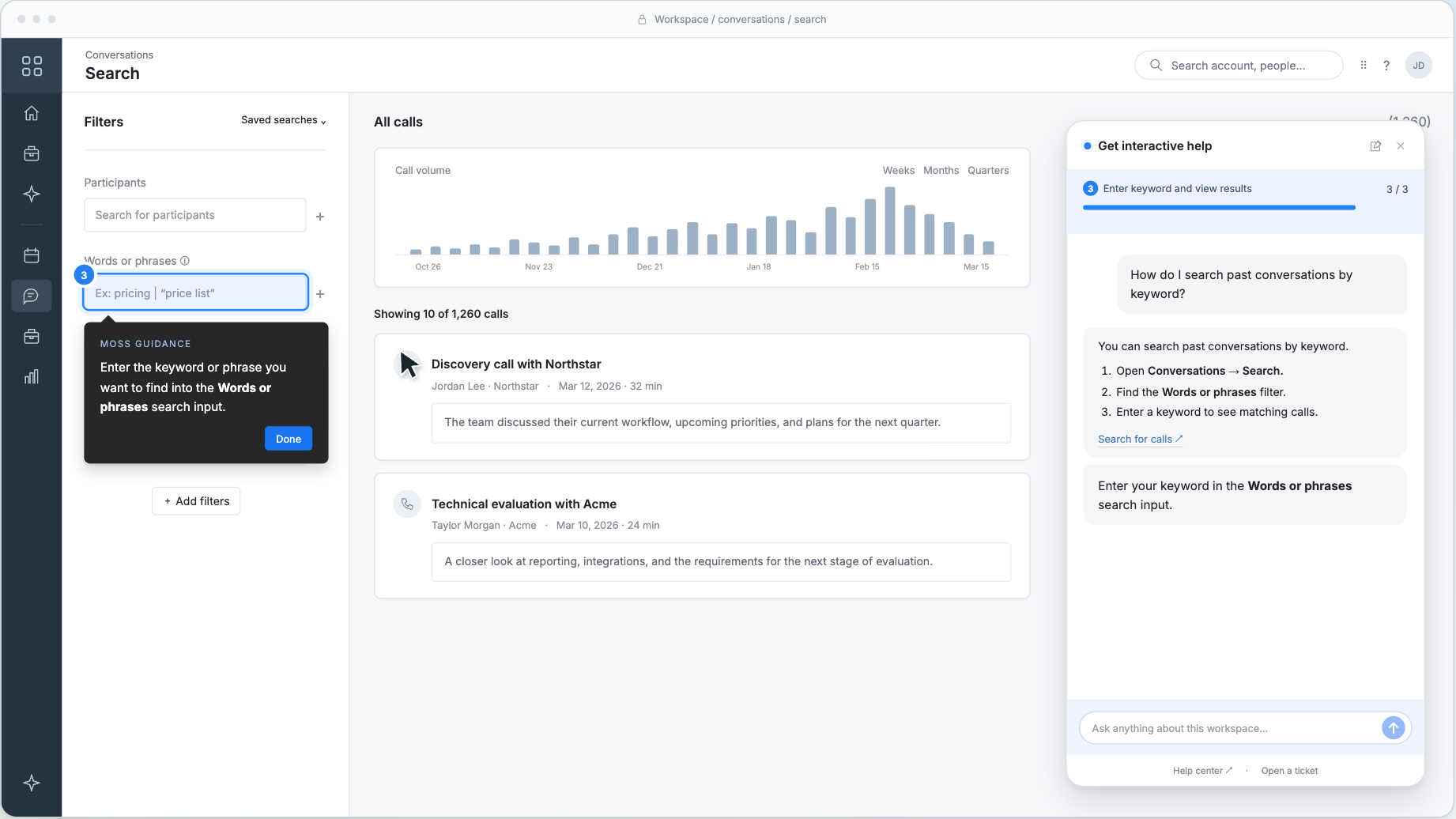
When a customer asks how to do something, Moss uses your help content and their current screen to answer—and points to the next control.
- Moss handles
- Answer from connected documentation, then guide the next action inside your product.
- Your team controls
- Choose the knowledge Moss uses and the requests that need a person. Zendesk handoffs can include the conversation and page context.
For your customers
Take customers through the whole task.
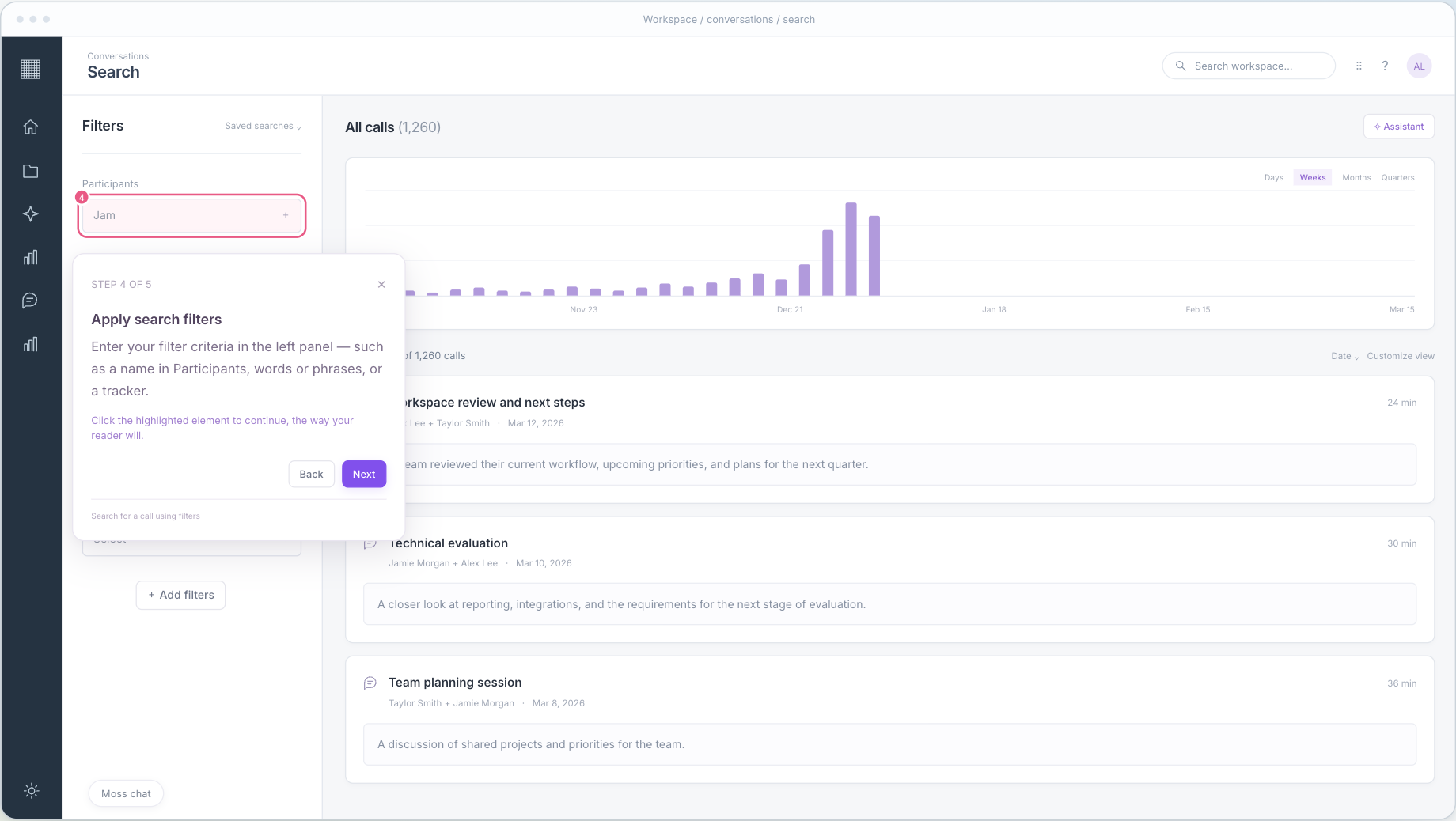
Help someone complete setup, learn a feature, or finish an unfamiliar workflow. Generate guidance for the task and save useful walkthroughs to use again.
- Moss handles
- Locate controls on the live screen and guide the sequence. If a saved target cannot be found, Moss can re-plan the guidance.
- Your team controls
- Review the flow and choose when to show it—by page, first browser visit, or user properties provided by your app.
For your customers
Give the agent a process it can follow.
Some questions need more than a helpful answer. Write the checks, permitted actions, and handoff rules in plain English so Moss can follow your support process.
- Moss handles
- Follow the procedure, use the tools configured for your application, and guide the customer or pass the request to your team.
- Your team controls
- Define the allowed actions and escalation conditions. Test procedures in a sandbox, then publish the version your team has reviewed.
For your team
See where support needs attention.
Define what good support looks like. Moss checks sessions against your criteria and brings the conversations that need attention into a review queue.
- Moss handles
- Look for signals such as repeated steps, frustration, or a procedure that failed to resolve the request. Attach the reasoning and session evidence.
- Your team controls
- Set your criteria and review the findings. The conversation stays attached so your team can check the assessment.
For your team
Go from a recurring issue to a concrete change.
Ask why customers keep getting stuck, examine the supporting sessions, and follow up. Copilot helps your team turn the findings into a proposed update.
- Moss handles
- Investigate sessions alongside your knowledge and procedures. Draft a proposed change and keep the supporting evidence with it.
- Your team controls
- Challenge the diagnosis, edit the proposal, or dismiss it. Your team reviews and approves changes before they are published.
See Moss at work in your product.
See how Moss answers a customer’s question and guides them through the task. In a demo, we’ll explore how that could work in your product.
Book a demo